

What are the main cybersecurity risks for businesses? We explore key threats, common mistakes, and the crucial role of people, processes and technology in protecting data.
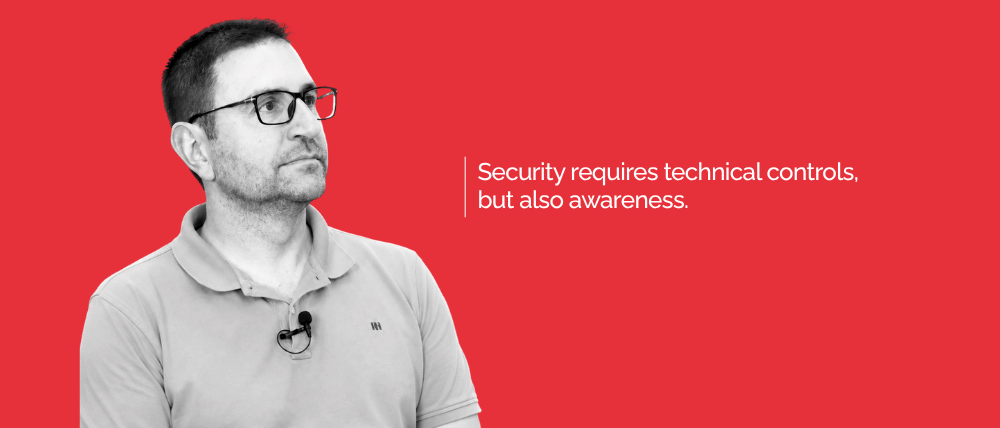
Is technology enough to protect a business from cybersecurity threats? As the waste sector becomes increasingly digital, protecting systems, data and people is more important than ever. And people themselves, one of the main targets for attackers, play a fundamental role in creating a safer digital environment.
We spoke to Vicente Quintáns, Head of Systems and Security at TEIMAS, about the main cybersecurity threats facing businesses, the mistakes companies continue to make, and why an effective security strategy needs to combine technology, people and processes.
One of the main threats is credential theft, as it can provide access to both internal systems and customer information.
It is also important to pay attention to software and third-party vulnerabilities, as well as threats such as ransomware.
In any case, no risk should ever be considered completely resolved. Cybersecurity requires continuous effort.
People remain one of the main targets for attackers and one of the weakest links in the chain, particularly when it comes to credential theft.
That is why it is essential to act with caution: check unexpected requests and, if in doubt, seek advice before proceeding.
Technology helps, but to be truly effective, it needs security-aware people and clear processes.
A security culture is built by integrating security into everyday work. Simply putting controls in place is not enough. Everyone within an organisation needs to understand their responsibility when it comes to security.
This means combining technical controls, continuous training, clear procedures and a culture where asking questions when in doubt is considered good practice.
Simply having a backup is not enough. You need to make sure that you can actually recover the data from that backup.
Backups that have never been tested for restoration are one of the cybersecurity mistakes that are still frequently seen.
In addition, to protect against threats such as ransomware, write-only mechanisms can be used to prevent backups from being modified.
It is important to practise response procedures because a response that has never been rehearsed can fail when it is needed most.
Monitoring, prevention and regular exercises help organisations to be better prepared to respond quickly to a potential incident.
At TEIMAS, information is protected at different levels, from analysis and development to infrastructure, access control and continuous monitoring.
We also have backups and restoration procedures that are tested regularly. Our backups include write-only mechanisms to prevent them from being modified, providing greater protection against ransomware attacks.
One of the main mistakes is relying solely on technology.
Practices such as sharing credentials, granting excessive permissions, failing to keep systems up to date or, as mentioned above, having backups whose restoration has never been tested are still common.
A robust security strategy requires technical controls, but also individual access credentials, awareness, continuous training and clear procedures. Ultimately, technology is a fundamental part of cybersecurity, but it does not work in isolation: people and processes are also part of the system.
Related articles:
.png)
.png)
